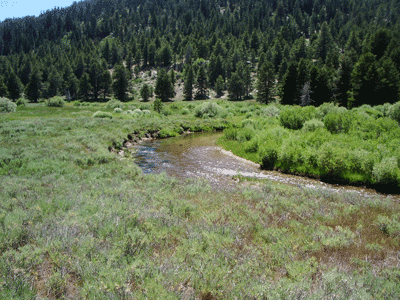
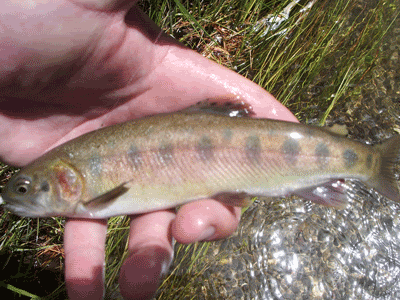
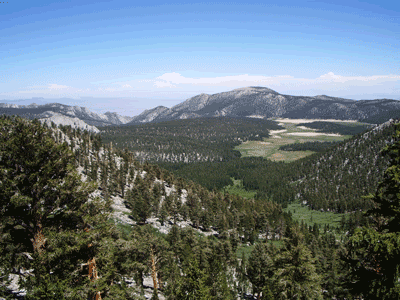
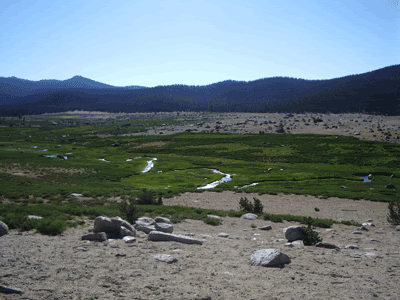
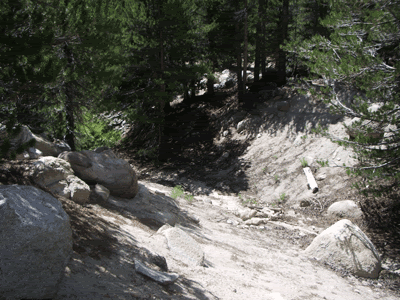
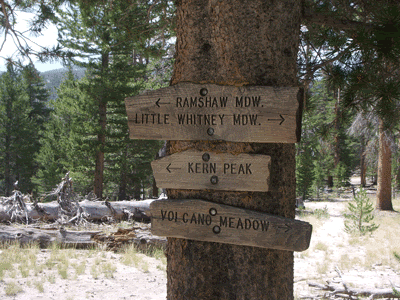
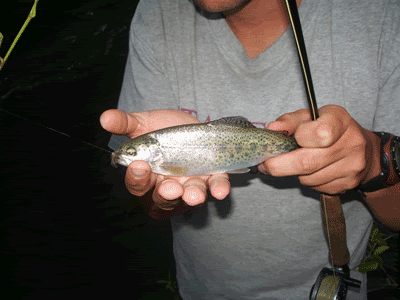
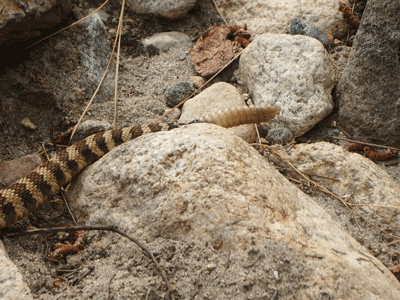
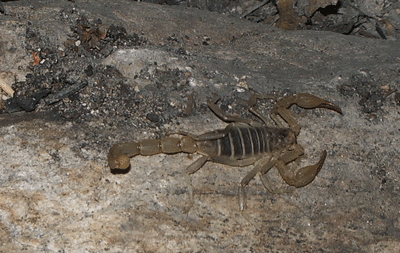
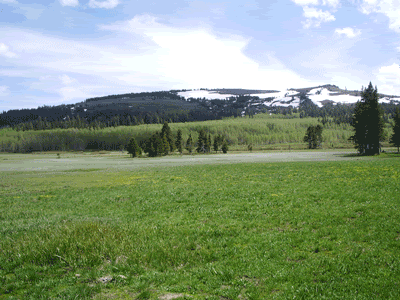
The trip started in Norcal with a couple days at the Pit, the McCloud and some tributaries of the McCloud where the first redbands were caught. From there we headed northeast through Alturas and fished for Goose lake redbands and Warners. We saw a bald eagle at this spot, which had lots of water, few fish, and required an extra couple miles of hiking because the roads in were north facing and under a few feet of snow. This was the only place where we were not able to get the fish we were after--we only found a few fish after hours of looking and when I finally hooked one it got off before I got it in hand. Very disappointing. Here is the area:
From here we went up to Lakeview Oregon and spent the night and went out on the town. If you are ever in Lakeview I highly recommend going to the bar. From Lakeview we made the long haul to Sun Valley where we fished the Big Wood and some tribs. Afer spending a few days in Sun Valley we headed on towards Wyoming to get started on the cutt slam.
Our first target was the Fine Spotted Cutt in the upper stretches of the Greys river. We talked to some people who had fished the area and the word was that the Greys was fishing tough because of runoff (this was around July 1st), but we headed up anyways and struck camp late that night. I was the first one up the next morning and went off to the river solo while my buddies slept. After trying some dries, some nymphs and some droppers with no success I switched to a bugger that I had used in Idaho with some success and had come to call "Big Ugly". Big Ugly did his job on his first run through a deep slot and brought this nice fish to hand:
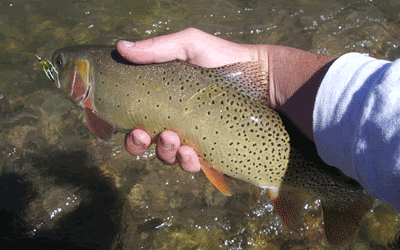
A little later in the afternoon my buddy Steve hooked up, and then a nice mayfly hatch came off and we were treated to some outstanding dry fly fishing. Before too long we all had our first Cutts in the bag and were 1/4 of the way to our cutt slam goal.
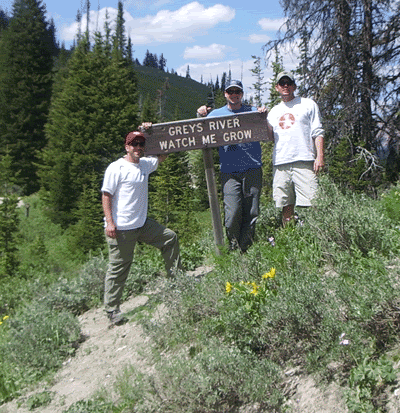
The next day we drove up past the headwaters of the Greys where the Wyoming forest service has this sign, which we passed right as we were discussing how cool it was to drive the entire stretch of river--from big water down near Alpine to a foot wide trickle up near the pass.
Next we had our sights set on the Bonneville Cutt, and for this we were able to get access to some nice water on the Smith Fork about 15 miles outside of Cokeville. The Smith fork was also fishing tough, as it was high and dark with runoff. A local had told us that the river was just getting fishable and that some folks had had some luck recently using worms, but that they hadn't heard of any fly fishers trying yet. Well, we were on a mission so we were about to find out if the Bonnies would move for a fly. My buddy Steve hooked up with a Stimulator on his THIRD! cast and had fish #2 in the bag. This happened just at dusk the night we arrived. We figured we were going to kill it the next day given Steve's success and the fact that we had miles of private river at our disposal that had not been fished much at all (if any) this season. This was not to be the case...
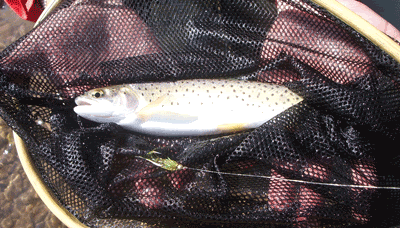
We fished hard the entire next day trying dires, nymphs and streamers. When those didn't work for Cutts (we got some browns and some whitefish to move however), I broke out the only two worm patterns I had with me and gave one to my other buddy Mike and tied one on myself below a copper john. Mike hooked up shortly thereafter, right around 2:00 in the afternoon using the worm. I promptly lost mine. He gave me his and I promptly lost it too. I fished from dawn until dark that day with no Cutt to show for it. The next day we got up early and tried again. My buddies, who were now my guides, were convinced that nymphing was my best shot given the water conditions. After a few more hours of fishing I was starting to sweat and was about to start digging for worms when I tied on Big Ugly at a promising looking slot and promptly got a fish to come up, but the hook did not set. I immediately sent Big Ugly back into the hole and once again the fish came. This time he hit hard and I stuck him. Steve was immediately in the water with some fine net work and my second fish of the slam was at hand. I have never been as excited to catch a fish as I was when I landed this little guy:
After some quick celebrating we headed straight to camp to pack up and go after our next fish: the Colorado Cutt. My pre-trip research had indicated that a great spot to catch Colorado Cutts was in the upper reaches of Fish Creek. So we left the ranch and drove a bit south around the mountains, over to Kemmerer, and on up to Big Piney where we made a left back toward the mountains and the upper reaches of Fish creek. As soon as we arrived we were treated to the sight of countless rising fish in the meadow we were planning to camp at. We got out of the car and geared up as fast as we could with the hopes of some great dry fly fished to rising Cutts. We stalked our first fish and brought a nice brookie to the net. And then another, and another, and another...I have never been so disappointed to catch brookies in my entire life. This continued until dark. The next day we were up early and headed even further upstream hoping to find Cutthroats. We had no such luck and continued to catch brookies as far up as we were able to hike.
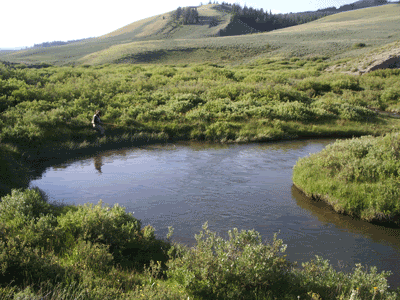
Disappointed we drove back to town to regroup and decide where else we could try to catch our quarry. We were lucky enough to run into a forest service biologist who pointed us toward a much more remote (if that is possible) creek which I will refrain from naming here. Suffice to say this creek produced in a big way. I can not imagine a more quintessential Wyoming trout stream, and will consider myself lucky if I ever have a fly fishing experience like the one we had there again in my life. This creek had meandered itself into perfect S turns through miles of meadow and seemingly held more fish than water. Here is a nice Colorado Cutt I pulled out (note the fly):
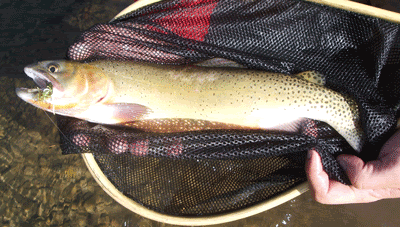
In addition to the larger fish I tempted out of the bank with Big Ugly, dozens of fish were caught on dries and the hatch grew so thick it was tough not to inhale bugs. Here is a picture of the creek from the road:
It was hard for us to leave this magical spot but we were on a mission and we also felt like celebrating a bit so we left and made our way over to Pinedale for some food and drink and a hotel room. We found the food and drink but, unbeknownst to us, we had arrived during the "Mountain Man" festival and not single room was left in the entire town despite the large number of hotels around due to Pinedales rapid growth since natural gas was discovered there a few years back. With no rooms available in Pinedale we decided to drive up toward Jackson and camp along the Hoback river.
Our next target was the Yellowstone Cutt. Because the Yellowstone river is closed for spawning until July 15th we would either have to fish the lake or find another stream. We had heard good information about the population of Yellowstone Cutts in the north fork of the Shoshone, so after a day in Jackson we drove up through Yellowstone and out the east entrance. We decided that rather than fish near the road we would do some hiking and get up into the backcountry a bit. We spent that night at Pehaska Tepee and hiked in the next day. The Forest Service had told us that there were over a dozen active grizzly bears in the area we planned to fish so we armed ourselves with bear spray and set out up the trail. After a few miles we found some great looking water and started to fish. My buddy Mike dredged up a huge rainbow with a black bugger and I turned a big fish on a stimmie but it was not to be. Steve and Mike both landed Cutts after an hour or so of fishing, but for some reason I could only get cutbows and rainbows to the hook. Once again I was the last one to catch our target fish and it was starting to get late and we still had a good walk back. After catching a dozen or so bows and hybrids I worked my way to a good looking hole, which required a sketchy river crossing, I once again tied on Big Ugly and immediately got a fish to move, but it wiggled free before I could get a photo (I had forgotten the net in the car). After a few more casts another fish hit and once again Steve was in the water to land it. The final Yellowstone Cutt:
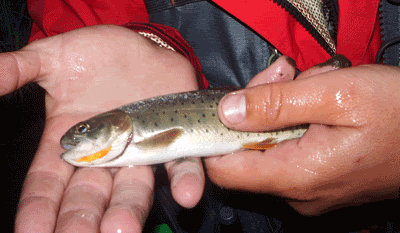
I figure that I am probably the only person to ever complete the Cutt Slam using the exact same fly for eachof the four species. I'm probably also the only person that has tried. Suffice to say, Big Ugly was retired that night on the north fork and I plan to mount him with my certificate.
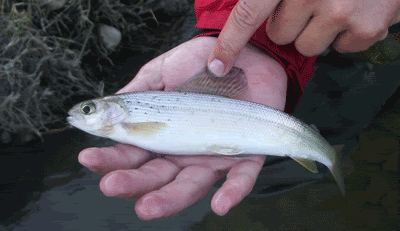
After completing the slam we went back to Yellowstone and fished the Madison and the Firehole for a few days before heading out West Yellowstone and on up toward the Madison river valley. Although rather than spend too much time with crowds nce again headed into the back country, this time in search of grayling in the upper Ruby. Man, were they there, and were they ever hungry for dries! Here is a nice upper Ruby grayling:
I also took this picture that night when we stopped fishing. Look closely.
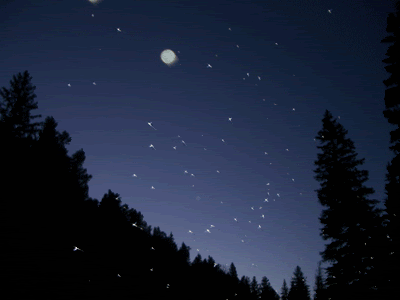
After a great night of fishing and a great night of camping, we woke up the next morning and hit the water again. Although the grayling weren't coming up in the morning so we decided to see what we could dredge up on streamers. It turns out that there are some pretty nice bows mixed in there with all the grayling:
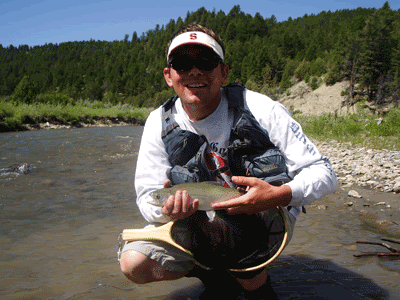
Well, I doubt anyone has read this far so I will end here by saying that from the Ruby we fished our way up to Missoula and were rewarded on our last day of fishing with some nice Westlope Xutts on a ranch we had gotten access to. Oh, I almost forgot one last thing--from Missoula I went to a family reunion in S. Carolina and was able to sneak in a day to get some of these guys:

Ok, that’s it.